
The United Nations has designated 2026 as the International Year of Volunteers for Sustainable Development (IVY 2026), launching on International Volunteer Day, December 5, 2025. The initiative recognizes volunteerism as a critical driver of social, economic, and environmental progress worldwide.
This declaration reflects a growing consensus: volunteerism is not peripheral to sustainable development. It is foundational.
Volunteers contribute across nearly every dimension of the 2030 Agenda for Sustainable Development, supporting climate action, public health, education, poverty reduction, and community resilience.
Just as importantly, IVY 2026 introduces a clear expectation for how volunteerism must be supported moving forward: through better measurement, stronger systems, and more intentional infrastructure.
Understanding IVY 2026
The International Year of Volunteers for Sustainable Development (IVY 2026) was proclaimed by the United Nations General Assembly through Resolution 78/127.
It calls on governments, nonprofits, civil society, and the private sector to recognize volunteerism as a key driver of sustainable development—and to strengthen how volunteer contributions are measured, supported, and reflected in decision-making.
The Challenge of Measuring Volunteer Impact
Volunteer contributions are integral to community resilience and social infrastructure.
Volunteers support disaster response and long-term recovery, sustain mutual aid networks, provide caregiving, strengthen civic participation, and contribute specialized skills across sectors. These efforts occur in both formal and informal settings, at local and global levels, and through in-person and digital engagement.
Despite their scope and importance, volunteer contributions are often underrepresented in policy planning and development frameworks. A key reason is the absence of consistent, reliable data that captures not only participation, but outcomes.
When volunteer activity is difficult to quantify or compare, it is less likely to be incorporated into strategic decision-making or long-term investment.
IVY 2026 directly responds to this gap. In a recent webinar discussion, Towards 2026: Shaping Your Future in Volunteer Engagement, Faiza Venzant, CVA, Executive Director of the Council for Certification in Volunteer Administration, described how a central emphasis of IVY 2026 is that evidence matters.
”The Sustainable Development Goals challenge us to measure impact in ways that go beyond feel-good stories,” Faiza explains. “They ask us to link volunteer data to real, measurable outcomes.”
Strong volunteer data collection and measurement frameworks are essential to:
- Understand the scale and diversity of volunteer contributions
- Identify effective approaches and where they deliver the greatest impact
- Ensure volunteerism is reflected in development planning, funding, and policy decisions
Without credible, comparable data, volunteer impact remains difficult to benchmark, evaluate, and sustain—limiting the sector’s ability to demonstrate value and improve outcomes over time.
Expanding How Volunteer Contributions Are Measured
Many volunteer programs have traditionally focused on participation-based metrics: volunteer counts, shifts filled, or hours logged. While these indicators remain useful, they provide an incomplete picture of impact.
The UN’s framing of IVY 2026 signals a broader approach—one that emphasizes contribution rather than participation alone.
This includes:
- The skills and expertise volunteers bring
- The populations and communities served
- The outcomes associated with volunteer efforts
- The alignment of volunteer activity with Sustainable Development Goals (SDGs)
Capturing this level of insight requires more than manual tracking or disconnected tools. It requires volunteer technology designed specifically for managing, analyzing, and reporting on volunteer engagement at scale.
The Role of Volunteer Technology in IVY 2026
The goals of IVY 2026 cannot be realized without modern volunteer management infrastructure. As Faiza observed,“Volunteering doesn’t just happen. It requires infrastructure, investment, and intentional systems that support people before, during, and after service.”
As expectations around evidence, inclusivity, and scalability increase, so does the need for technology that can support those expectations.
Volunteer management platforms like Get Connected by Galaxy Digital are built to address this shift. They enable organizations to move beyond decentralized tracking and toward a more comprehensive understanding of volunteer impact.
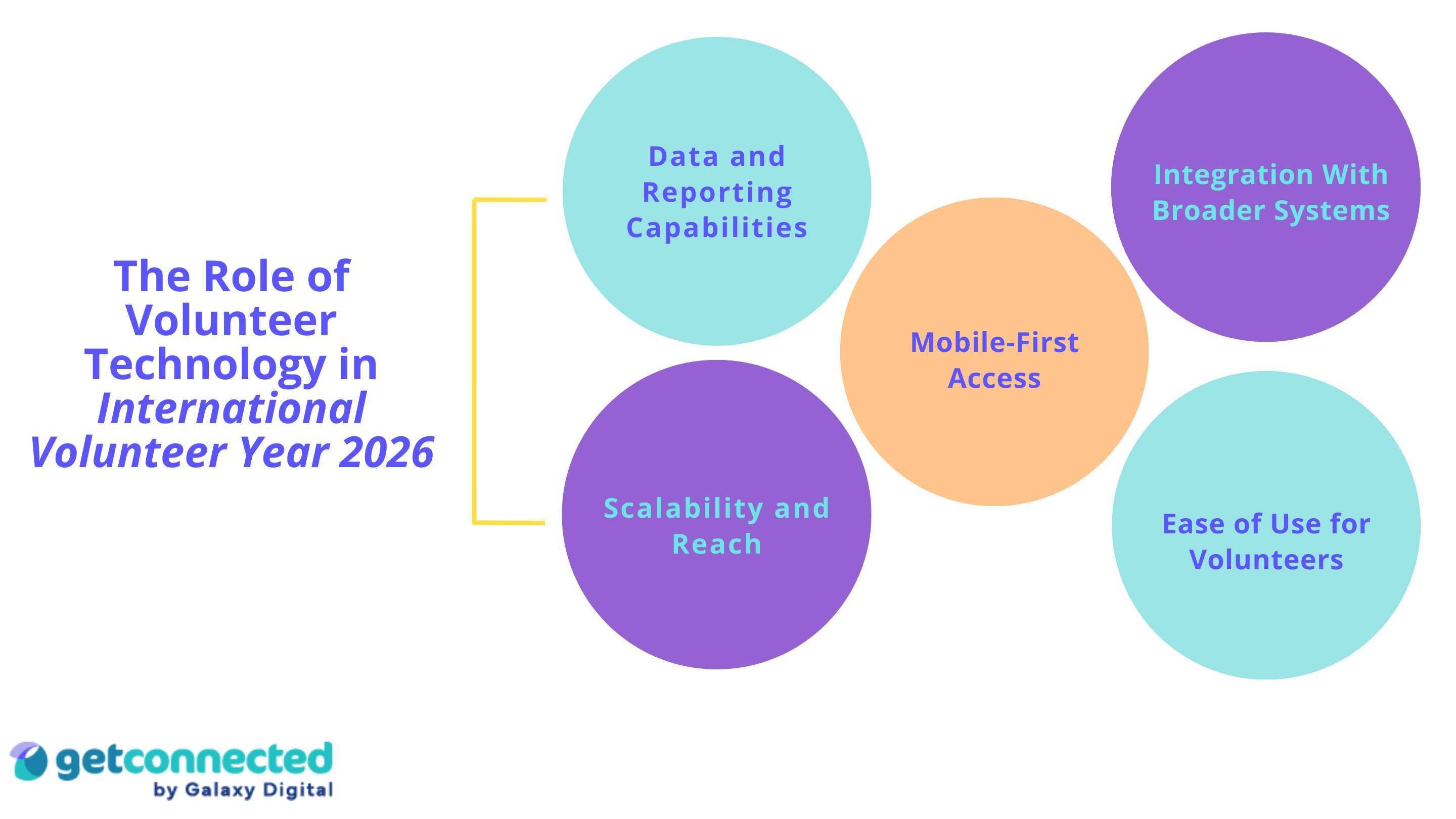
At a practical level, effective volunteer technology supports IVY 2026 by providing:
Data and Reporting Capabilities
Volunteer management systems can track hours, skills, and participation across programs, initiatives, and geographic areas. When aligned with reporting frameworks, this data can be used to demonstrate contributions to specific SDGs and broader community outcomes.
Scalability and Reach
IVY 2026 is expected to increase public engagement with volunteerism. Technology enables organizations to manage growth—whether at a local, national, or international level—without compromising coordination or staff capacity.
Mobile-First Access
Mobile functionality allows volunteers to engage on their own terms, supporting on-the-go sign-ups, check-ins, and communication. This accessibility is particularly important for reaching younger volunteers and communities with limited access to traditional systems.
Integration With Broader Systems
Integrations with tools such as Salesforce allow volunteer data to connect with fundraising, communications, and program management. This creates a more holistic view of supporter engagement and strengthens organizational decision-making.
Ease of Use
To be effective, volunteer technology must be intuitive for both coordinators and volunteers. Simple, accessible interfaces reduce friction and support sustained participation.
Supporting Inclusive Volunteer Engagement
Another core pillar of IVY 2026 is inclusivity. The United Nations emphasizes that volunteering must be accessible to people of all identities, abilities, and backgrounds, and that barriers to participation must be actively addressed.
In the webinar Faiza Venzant explains, “Volunteering only thrives when people are safe, supported, and protected—and when everyone can see themselves reflected in how service is designed.”
Volunteer technology plays a critical role in supporting this goal by removing barriers to participation and helping organizations design more accessible pathways to service.
When implemented thoughtfully, volunteer systems can:
- Support digital and remote volunteering opportunities, expanding access for individuals who may face geographic, mobility, or time-related barriers
- Enable skills-based matching that recognizes a wide range of expertise and lived experience, not just availability
- Simplify onboarding, communication, and coordination, reducing friction that can discourage participation
By making engagement more flexible and transparent, volunteer platforms help ensure that all forms of volunteering—formal and informal, in-person and digital—are visible, supported, and valued. This infrastructure is essential to broadening participation and aligning volunteer programs with the inclusive goals of IVY 2026.
How to Prepare for the International Year of Volunteers
IVY 2026 represents both recognition and responsibility.
While it affirms the essential role volunteers play in sustainable development, it also raises expectations for how volunteer engagement is supported, measured, and communicated.
For volunteer organizations, preparation begins with an honest assessment of current systems and practices.
This includes evaluating whether volunteer data is being captured consistently across programs, whether impact reporting extends beyond basic participation metrics, and whether existing tools can support growth, inclusion, and more sophisticated analysis.
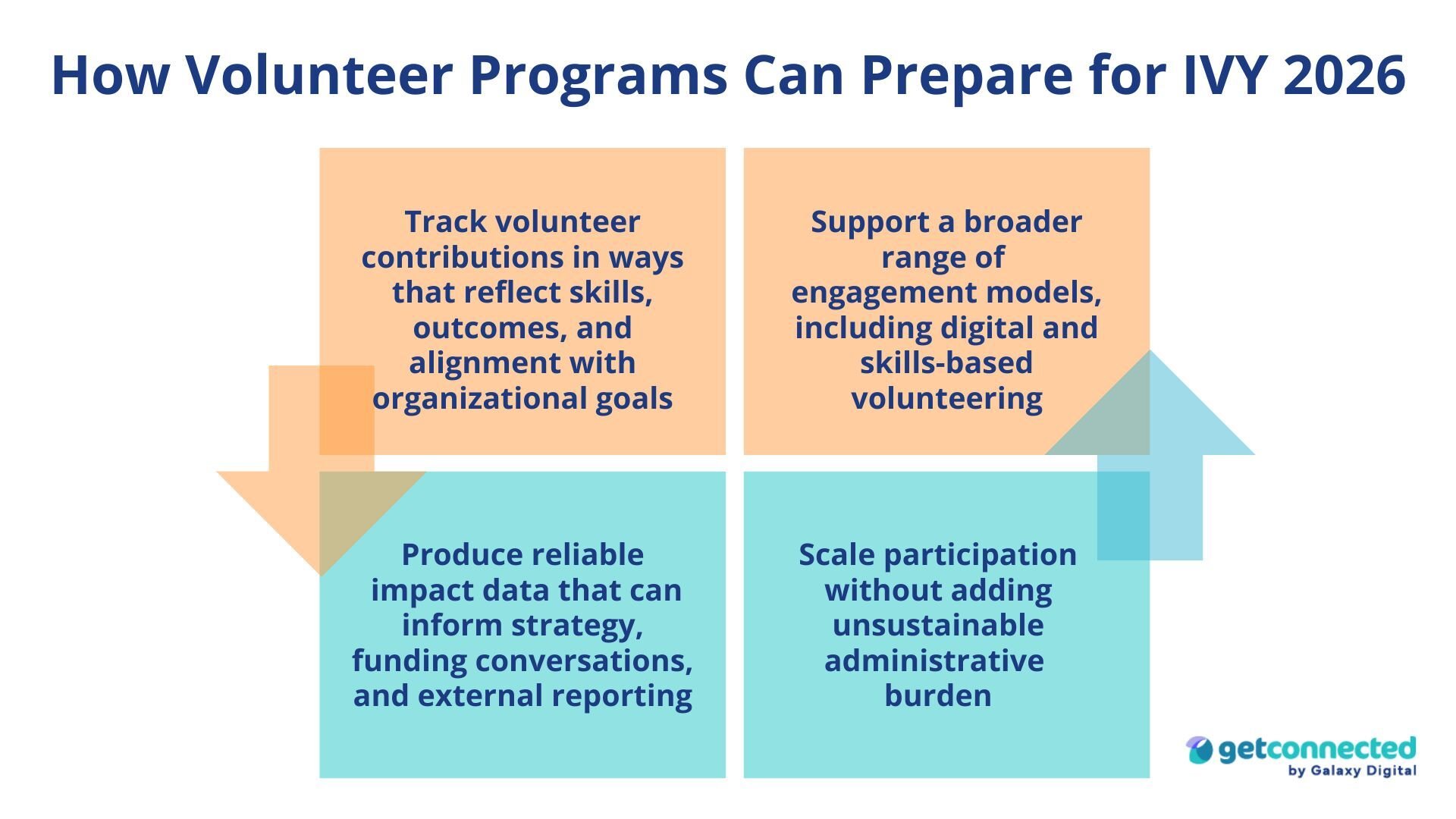
In practical terms, preparing for IVY 2026 means ensuring your volunteer program is equipped to:
- Track volunteer contributions in ways that reflect skills, outcomes, and alignment with organizational goals
- Produce reliable impact data that can inform strategy, funding conversations, and external reporting
- Support a broader range of engagement models, including digital and skills-based volunteering
- Scale participation without adding unsustainable administrative burden
Preparing for IVY 2026 is not just about readiness—it’s about being intentional in how volunteer programs evolve to meet rising expectations. As Faiza notes, “We’re not just preparing for another year. Collectively, we’re shaping the future of volunteer engagement—and that requires intention.”
Planning for IVY 2026 With the Right Volunteer Technology
The International Year of Volunteers presents a timely opportunity to evaluate whether your volunteer systems are equipped to support stronger measurement, inclusive engagement, and future growth.
A free demo of Get Connected by Galaxy Digital provides a practical way to assess how volunteer data is currently captured, where reporting or scalability gaps exist, and how your organization could better align volunteer engagement with emerging expectations for evidence and accountability.
Strengthening volunteer technology now helps ensure your organization is prepared for IVY 2026—and positioned to sustain more effective, data-informed volunteer programs beyond it.



![Feature Image for [Planning Calendar + Templates] Everything You Need to Prepare for Volunteer Month](https://www.galaxydigital.com/hs-fs/hubfs/pexels-christina-morillo-1181533.jpg?width=352&name=pexels-christina-morillo-1181533.jpg)

