50+ Free Volunteer Management Templates, Tools & Resources

Volunteer management has always been a balancing act between the heart for causes and the head for logistics.
As digital tools continue to reshape how organizations recruit, communicate with, and support volunteers, artificial intelligence has moved from a future concept to a present-day reality. Tools like ChatGPT are now part of everyday workflows for many volunteer leaders—but adopting AI responsibly requires more than curiosity or convenience.
For Volunteer Coordinators and Managers, AI is not about replacing human connection. It’s about supporting it—freeing up time, increasing clarity, and strengthening systems so volunteer engagement can remain people-centered.
This article explores how volunteer leaders can use AI ethically and effectively while keeping volunteers, values, and trust at the center.
How Volunteer Managers Can Get Started with AI
Getting started with AI does not require technical expertise—but it does require boundaries and intention.
Begin by creating an account with a tool like ChatGPT. Spend time understanding what the tool is good at—drafting, summarizing, organizing ideas—and what it should not be used for, such as making final decisions or handling sensitive volunteer information.
In Towards 2026: Shaping Your Future in Volunteer Engagement, Faiza Venzant, CVA, emphasizes that AI should be used deliberately, not reflexively. “You have to decide how you use AI," she says. "Nobody is forcing you to do anything, and you can take or leave whatever it gives you.”
[VIDEO] Towards 2026: Shaping Your Future in Volunteer Engagement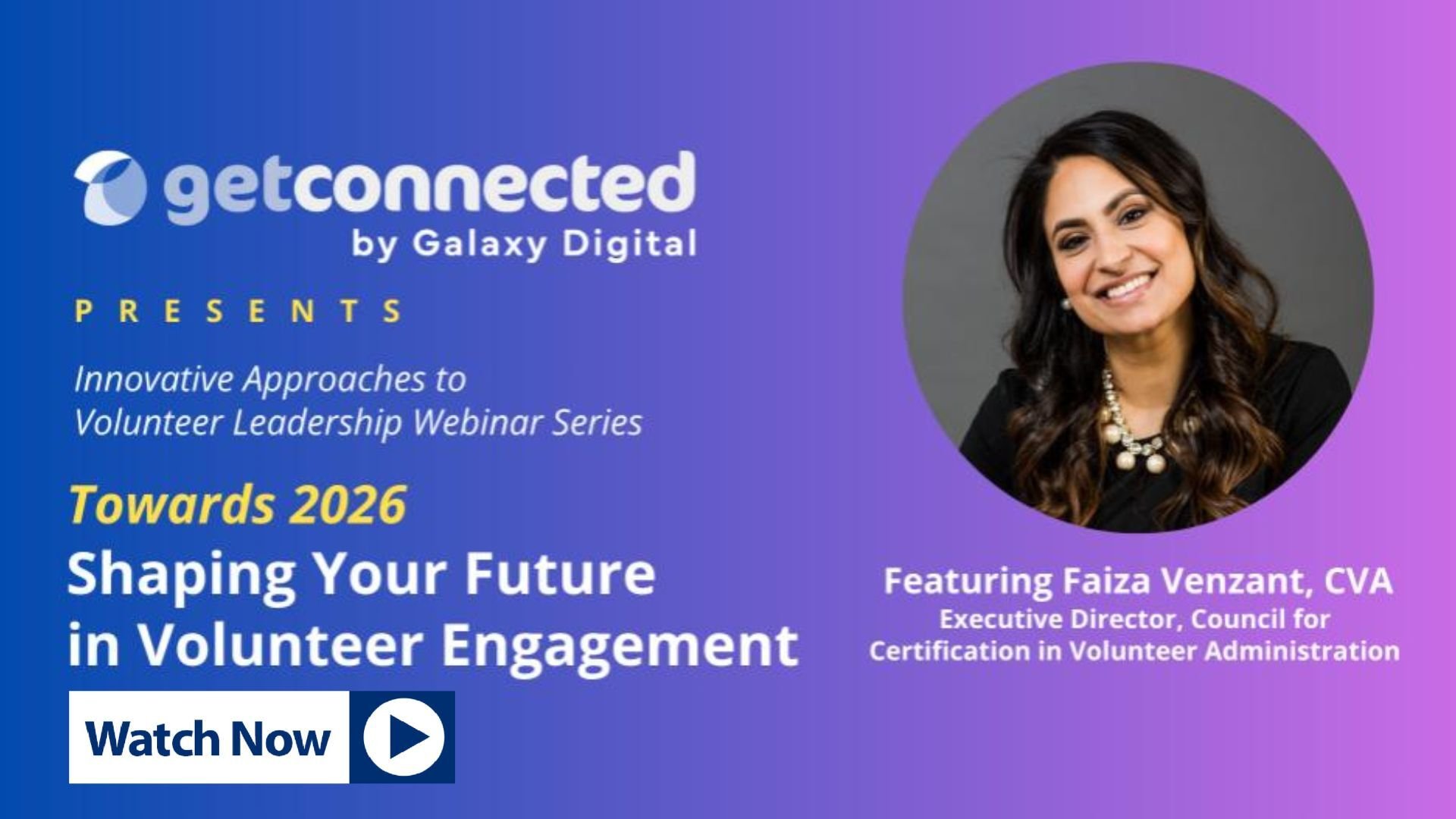
Faiza Venzant, CVA, names AI as a trend for Volunteer Leaders to watch >>
Most Common Uses of AI in Volunteer Coordination
When used responsibly, AI can support many of the day-to-day tasks that often pull volunteer leaders away from relationship-building.
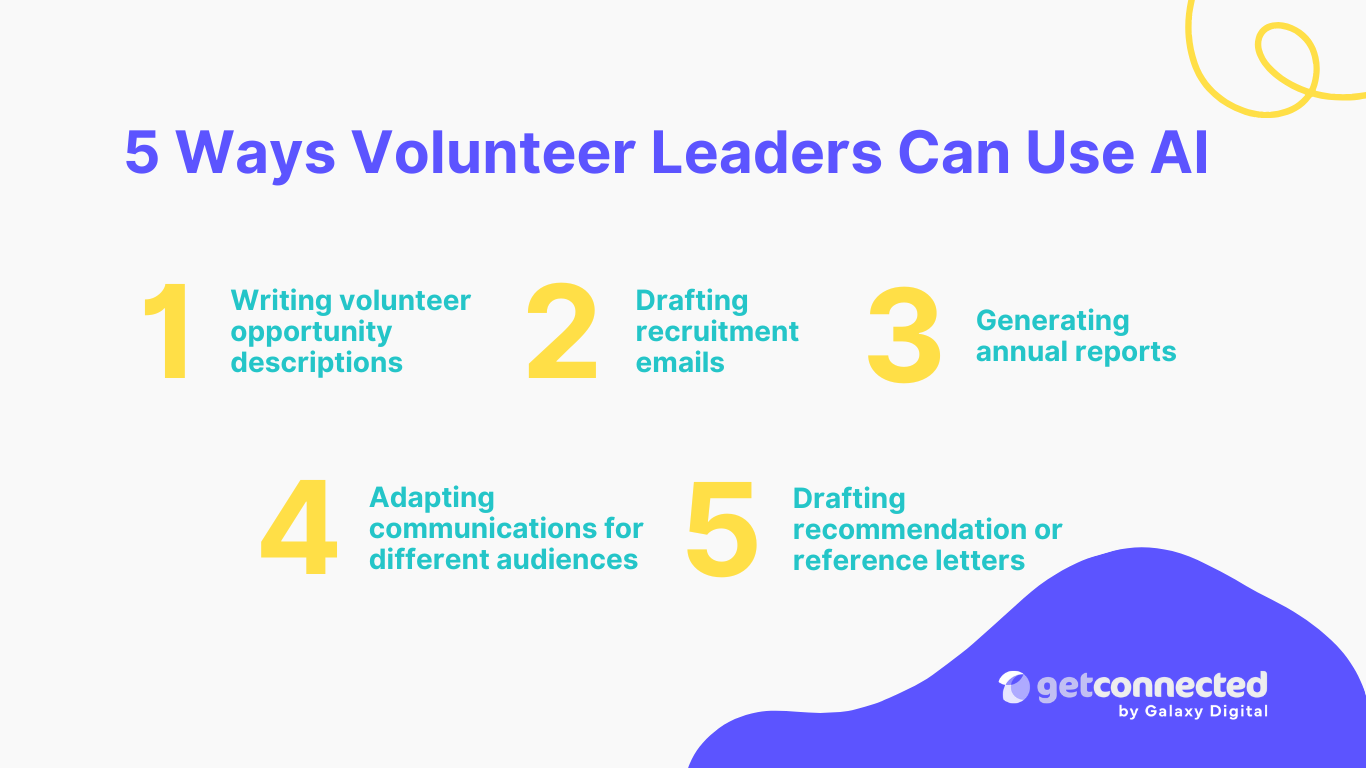
Volunteer leaders are commonly using AI tools for:
- Writing volunteer opportunity descriptions and role summaries. AI can generate clear first drafts outlining responsibilities, time commitments, and impact. This gives volunteer leaders a strong starting point that can be refined to reflect the organization’s voice and the real volunteer experience.
- Drafting recruitment and follow-up emails. AI can help draft outreach messages, reminders, and follow-ups that staff can quickly personalize. This supports consistent communication without sacrificing authenticity or relationship-building.
- Generating annual reports and impact summaries. Transforming raw data into visually captivating and compelling annual reports can be a challenging task. With the assistance of tools like ChatGPT, you can input your data and receive beautifully crafted annual reports that tell the story of your volunteer program's progress and achievements, providing valuable insights in a visually engaging format.
- Adapting communications for different audiences. AI is especially useful for rewriting materials for different reading levels, age groups, or for volunteers for whom English is a second language—supporting accessibility and inclusive engagement.
- Drafting recommendation or reference letters. AI can create professional, structured drafts that highlight a volunteer’s skills and contributions, allowing leaders to personalize efficiently.
While these use cases highlight the efficiency AI can bring to volunteer coordination, effectiveness alone is not enough.
Volunteer programs are built on trust, inclusion, and human connection—and any tool introduced into that ecosystem must strengthen, not strain, those foundations. This is where ethical AI use becomes essential.
The Role of the Volunteer Leader in an AI-Supported Program
AI can draft, summarize, and reorganize—but it cannot replace the judgment, empathy, and accountability of a volunteer leader. As AI becomes more common in volunteer engagement, the role of the Volunteer Coordinator or Manager becomes even more important, not less.
Volunteer leaders remain responsible for how volunteers are represented, how inclusive language is used, how data is protected, and how trust is maintained. AI may support decision-making, but it is the human leader who ensures those decisions align with organizational values and community needs.
In this way, AI is best understood not as a replacement for leadership, but as a tool that amplifies it.
Ethical AI: A Framework for Volunteer Leaders
As stewards of volunteer programs, it is our responsibility to use AI tools ethically, intentionally, and with care. Ethical AI use in volunteer engagement is not just about efficiency—it’s about trust, inclusion, and protecting the relationships at the heart of volunteerism.
A strong ethical foundation begins with a human-in-the-loop approach. AI tools should be actively guided, reviewed, and corrected to ensure they reflect the diverse communities volunteer programs serve.
Organizations should also set clear boundaries around what AI should and should not be used for, particularly when volunteer data or decision-making is involved.
In Towards 2026: Shaping Your Future in Volunteer Engagement, Faiza Venzant outlines four core commitments that are especially useful for volunteer engagement professionals using AI: intention, transparency, consent, and participation.
Intention
Ethical AI use starts with intention. Volunteer leaders choose how—and whether—AI is used in their work. AI should support clarity, reduce administrative burden, and improve accessibility, not replace human judgment or relationships. Intention sets the tone for ethical AI use and helps ensure technology serves volunteer engagement goals rather than driving them.
Transparency
Transparency is essential to maintaining trust.
“Be honest and clear when you’re using AI," Faiza says. "Let people know when they’re interacting with a chatbot and not a human.”
Clear disclosure reinforces ethical leadership and avoids confusion or misrepresentation.
Consent and Confidentiality
Consent is especially critical when volunteer stories, experiences, or personal information are involved.
“Before you use anybody else’s stories or information in AI, make sure you have consent and remove identifying details," advises Faiza.
Volunteer data often includes personal and sensitive information, and ethical AI use extends directly to protecting that data. Confidential information should never be entered into AI tools without clear safeguards and organizational approval.
Participation
Participation means staying engaged with the tool by reviewing outputs, correcting inaccuracies, and refining prompts over time so the AI continues to align with organizational values.
Ethical AI use is not a one-time decision. It requires active participation in training and review. Feeding AI tools a wide range of inclusive inputs, flagging biased or inappropriate responses, and discussing issues openly helps create a culture of accountability and continuous improvement.
Together, these commitments help ensure that AI supports—rather than undermines—the values of volunteer engagement. When used with intention, transparency, consent, and active participation, AI becomes a tool that strengthens trust, equity, and human connection instead of weakening it.
Managing Risk: Bias, Accuracy, and Ongoing AI Training
While tools like ChatGPT can streamline volunteer coordination, they are not without potential risks. Inaccuracies and biases may arise, making active oversight and ongoing training essential.
Understanding inaccuracies
AI tools are trained on large datasets, but they can misinterpret context or generate incomplete or incorrect information. Regular review of AI-generated content helps ensure that communications shared with volunteers remain accurate, appropriate, and aligned with organizational values.
Identifying and addressing bias
Despite extensive training, AI can reflect biases related to gender, race, culture, or other identities. Volunteer leaders should actively monitor outputs, flag biased or inappropriate language, and provide corrective feedback. This feedback loop is critical to promoting inclusive and respectful volunteer engagement.
-2.jpg?width=2049&height=1152&name=77%25%20of%20Nonprofits%20Callout%20%20-%20Website%20(1)-2.jpg)
Practical steps for volunteer leaders
-
Data selection: Use diverse, representative inputs when working with AI tools so outputs better reflect the full range of volunteers you serve.
-
Inclusive language review: Evaluate AI-generated content to ensure it respects identity, culture, and accessibility needs.
-
Bias correction: Actively flag and correct biased or problematic responses rather than accepting them as-is.
-
Ongoing improvement: Treat AI use as iterative. Regular reviews, adjustments, and refinements help ensure outputs remain accurate and appropriate over time.
-
Volunteer feedback: When appropriate, involve volunteers in identifying gaps or concerns in AI-supported communications and processes.
Proactive management, consistent monitoring, and an active feedback loop help ensure AI supports—rather than undermines—the trust, equity, and human connection at the heart of volunteer engagement.
The AI Toolkit: Beyond ChatGPT
While ChatGPT is currently one of the most popular tools used by leaders of volunteers, it's just one piece of the AI puzzle.
Here are some other AI tools that can augment your volunteer management strategy, each with its unique strengths:
- IBM Watson: Known for its powerful natural language understanding capabilities, Watson can be used to automate responses, analyze sentiments, and provide personalized interactions.
- Google's DialogFlow: Allows for the creation of conversational user interfaces, enabling volunteers to engage with your program through a chat interface that can be integrated into various platforms.
- Amazon Lex: This service provides advanced deep learning functionalities of automatic speech recognition and natural language understanding, offering a high-quality conversational experience to your volunteers.
- Microsoft Azure Bot Service: With Azure Bot, you can build, connect, test, and deploy intelligent, enterprise-grade bots that can enrich volunteer engagement and streamline processes.
- Rasa: An open-source AI tool, Rasa offers great flexibility and control, allowing you to build personalized volunteer experiences based on your specific requirements.
The Final Call-to-Action: Keep It Ethical, Keep It Human
Artificial intelligence offers real opportunities to reduce administrative burden and improve clarity in volunteer engagement. But its value ultimately depends on how it is used.
When guided by intention, transparency, consent, and active participation, AI can strengthen volunteer programs by giving leaders more time to focus on relationships, recognition, and meaningful engagement. When used without reflection, it risks undermining the very trust volunteer programs rely on.
Volunteer engagement has always been about people first. AI should serve that mission—not redefine it.
Used thoughtfully, AI becomes another tool in a volunteer leader’s toolkit: one that supports stronger systems, clearer communication, and more human-centered engagement. And in a field built on generosity, connection, and care, that distinction matters.